
Orchestrated automation for every certificate
Manage end-to-end certificate lifecycles throughout your entire technology stack from a single lightweight install, regardless of certificate origins.
Stay ahead of short lifespans, reduce operational load, and keep every endpoint trusted.
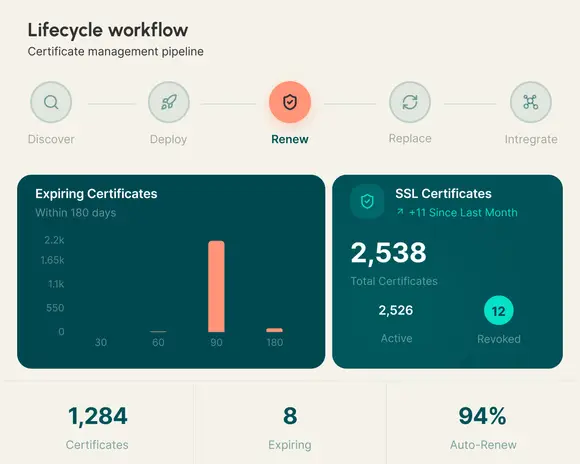
Total control of every certificate
Sectigo Certificate Manager (SCM) simplifies certificate lifecycle management with a CA-agnostic approach that automates discovery, deployment, and renewal, keeping every server and load balancer trusted and continuously authenticated.
Automate against shrinking certificate lifespans
Certificate lifespans are collapsing. By 2029, every public TLS/SSL certificate will be valid for just 47 days, making manual renewals difficult to maintain. Teams need automation that runs seamlessly.
SCM handles renewal and deployment automatically, so shorter lifespans do not add risk or workload.
Introducing Sectigo Orchestration Gateway within SCM
At the core of SCM, Sectigo Orchestration Gateway (SOG) provides a single orchestration layer that consolidates certificate operations and removes the complexity of running multiple agents, scripts, and connectors.

End-to-end automation at scale
Automates certificate discovery, issuance, renewal, and deployment in one continuous workflow inside SCM, keeping pace with 47-day lifespans and high-volume environments.

One gateway, many endpoints
A single install reaches servers, load balancers, CDNs, WAFs, and access systems, with no redundant VMs, separate HA setups, or per vendor maintenance cycles.

Ready for what comes next
Built for crypto agility, supporting algorithm transitions, evolving standards, and post quantum readiness. Adapt as environments grow and requirements change.
Precise control that keeps pace
Beyond the orchestration gateway, SCM brings together a full set of automation tools that handle every step of the certificate lifecycle so teams stay in control as environments grow and lifespans shrink.

ACME is the preferred automation protocol for public certificate issuance and management. Google highlights the ACME protocol as core to the automation of digital certificate lifecycles and lays out the benefits of automation in the context of shorter certificate lifespans. These include increased resilience and crypto-agility, which can help organizations more easily transition to quantum-resistant algorithms.
ACME allows you to automate certificate issuance and installation for a wide range of web servers, load balancers, routers, firewalls, and other networking gear. Sectigo supports DV, OV, and EV certificate types via ACME and provides full control to IT administrators.
Intelligent auto‑renewal from Sectigo ensures certificates are renewed automatically before expiry, eliminating the risk of outages caused by missed renewals. It reduces operational overhead by removing manual tracking, approvals, and last‑minute firefighting. By continuously validating and renewing certificates, it helps maintain uninterrupted security and compliance across your environments. The automation improves reliability and consistency, especially at scale where manual processes often fail. Overall, it delivers peace of mind, stronger security posture, and measurable time and cost savings for teams.
Policy enforcement in SCM ensures security policies are applied consistently across all certificates, environments, and teams. Administrators can centrally define rules for key lengths, algorithms, validity periods, and approval workflows, removing guesswork and manual variation. This guarantees every certificate issued aligns with organisational security and compliance standards by default.
SCM continuously enforces these policies throughout the certificate lifecycle, not just at issuance. Non-compliant certificates are prevented, flagged, or remediated automatically, reducing risk and audit exposure. The result is stronger governance, simplified compliance, and full confidence that security policies are always followed at scale.
Integration with your tech stack is seamless with SCM, allowing certificate management to fit naturally into your existing workflows. SCM integrates with leading platforms, cloud providers, DevOps tools, and infrastructure components through APIs and pre-built connectors. This enables certificates to be issued, deployed, renewed, and replaced automatically without manual intervention.
By embedding certificate management directly into your tech stack, SCM reduces friction between security and operations teams. Automation across load balancers, web servers, containers, and cloud services ensures security keeps pace with modern, fast-moving environments. The result is faster deployment, fewer errors, and consistent security across all systems.
Enterprise use cases

Keep services online
Renew and deploy every certificate on time, quietly, before anything expires.

Scale without adding overhead
Extend certificate operations across cloud, on prem, and edge from one central platform.

Simplify the tech stack
Replace scattered scripts with a single, orchestrated certificate lifecycle.

Stay always audit ready
A live inventory and central policy keep compliance in place by design.








50+ seamless integrations
Automated certificate lifecycle management that fits how your team already works. Connect seamlessly with essential business tools and platforms to automate and optimize every aspect of your certificate processes.
Where orchestrated automation pays off

Simplify certificate automation
Replace fragmented automation with a unified platform for discovery, issuance, renewal, and policy enforcement across teams, environments, and CAs.
Fewer outages, lower risks
Seamless automation removes the manual errors and missed renewals behind most certificate related downtime and security gaps.
Cut operating cost
Spend less by automating certificate management. A single platform replaces fragmented connectors, scripts, and VMs, freeing teams from repetitive work.
Stronger security posture
Comply with industry regulations and standards. A current view of your full certificate inventory, with central policies enforced at every lifecycle action.
Keep pace with evolving changes
Easily manage growing numbers of digital certificates and scale them across increasingly complex enterprise network environments.
FAQ
A single, automated certificate workflow that runs discovery, issuance, renewal, and deployment across every server, cloud, and edge platform in your stack, governed by central policy.
Discovery, enrollment, issuance, deployment, renewal, and revocation, all as one continuous flow rather than separate steps.
Every lifecycle action is logged and policy enforced, giving auditors a live, verifiable record without manual reporting.
ACME and scripts automate one task at a time. SCM orchestrates the full lifecycle across many endpoints with central policy enforcement.
Yes. Orchestrated automation works across Sectigo and third party CAs from one platform, with consistent policy applied to every certificate.