












Verified Mark Certificates (VMC) Datasheet Go to Verified Mark Certificates (VMC) Datasheet
Email is key for engagement but risky. Sectigo Verified Mark...
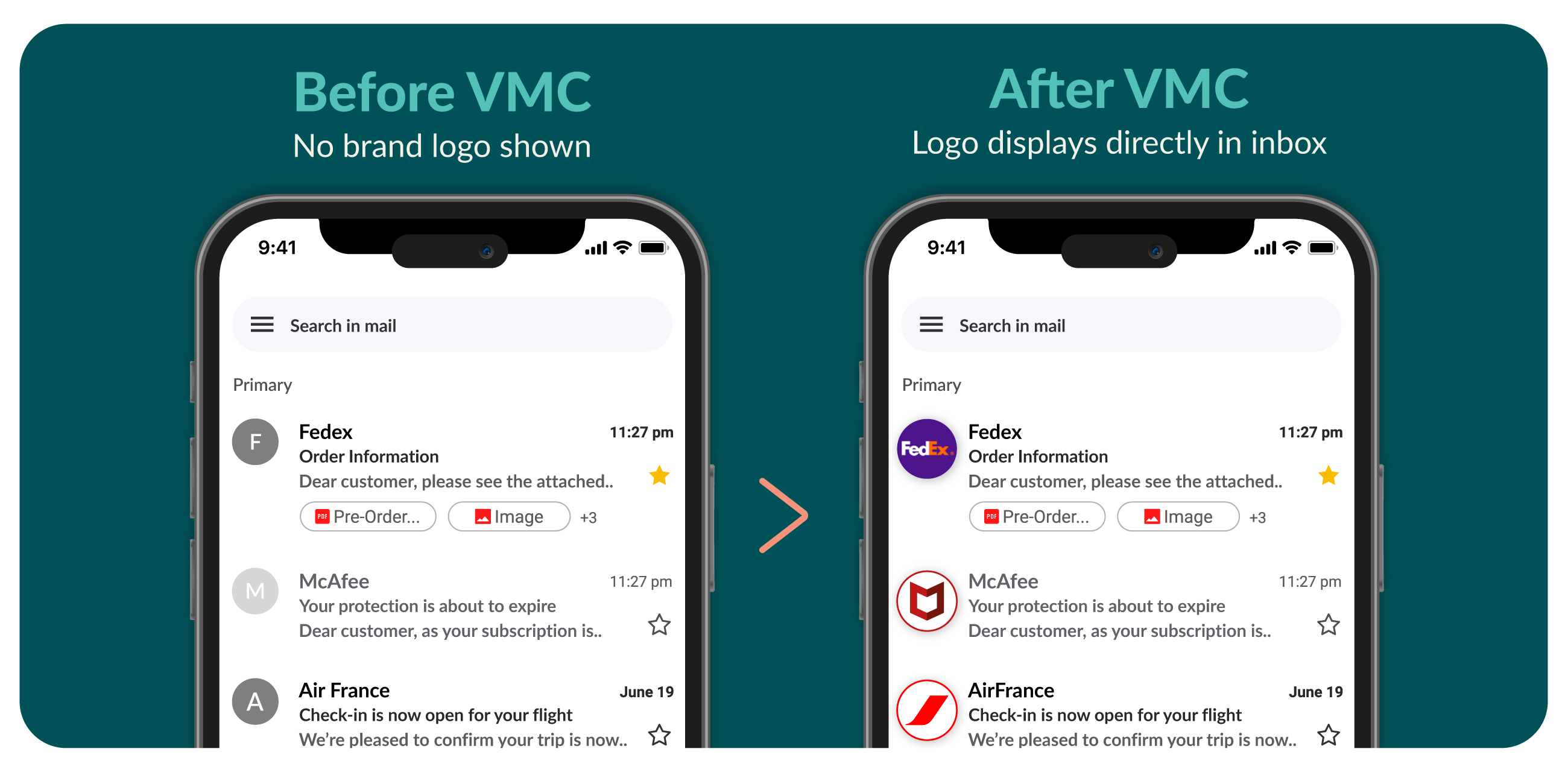
In crowded inboxes, your emails compete for attention. A Verified Mark Certificate (VMC) helps your messages stand out by displaying your organization’s registered trademark logo next to your emails in inboxes that support BIMI (Brand Indicators for Message Identification). BIMI is the email standard that enables verified logo display in supported inboxes, while a VMC verifies your organization and confirms that your trademarked logo is authorized for use with BIMI. With a VMC, your emails:
Your choice of certificate determines how your brand appears in inboxes, the trust you build with customers, and how quickly you can go live
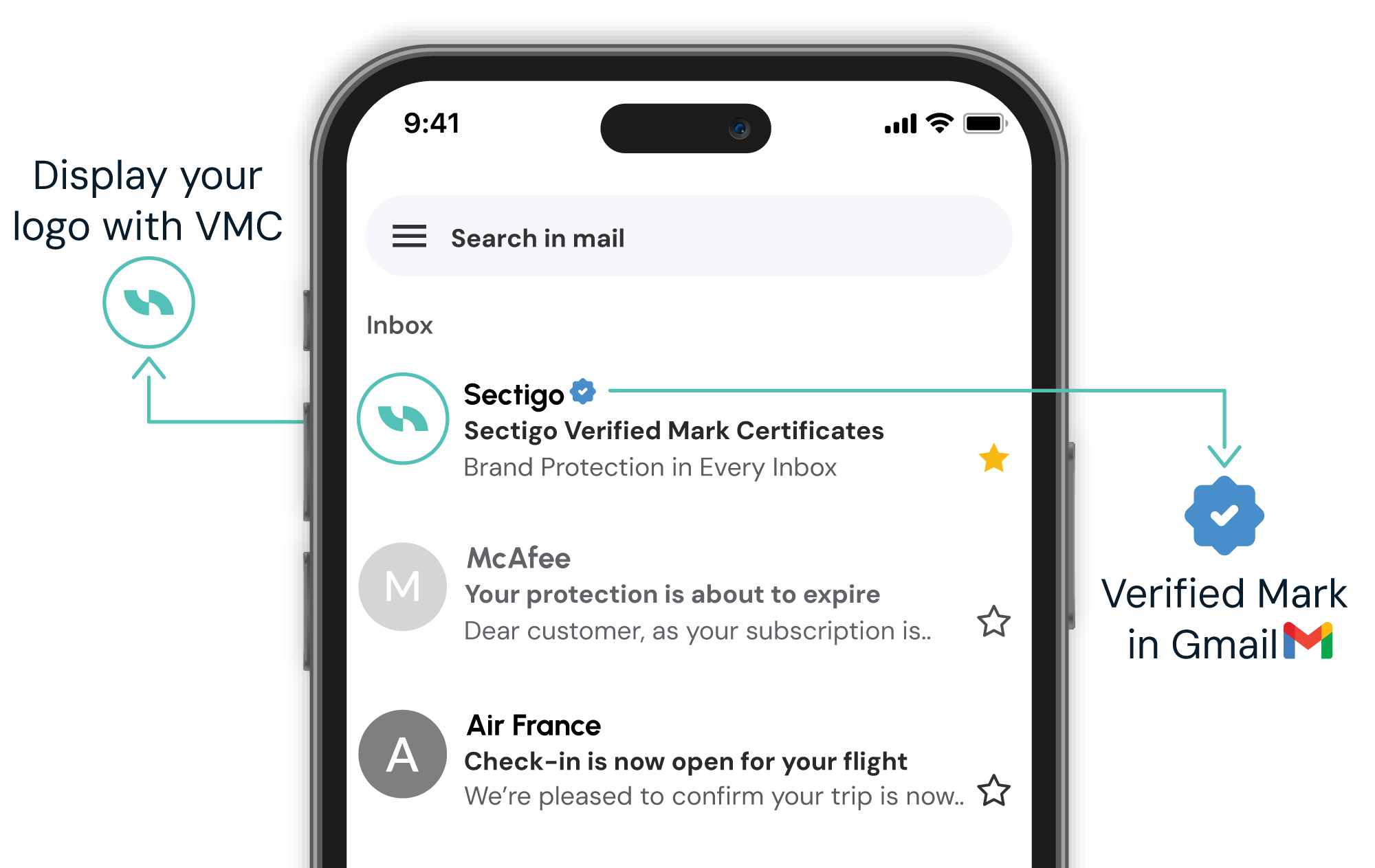
Choose VMC if:
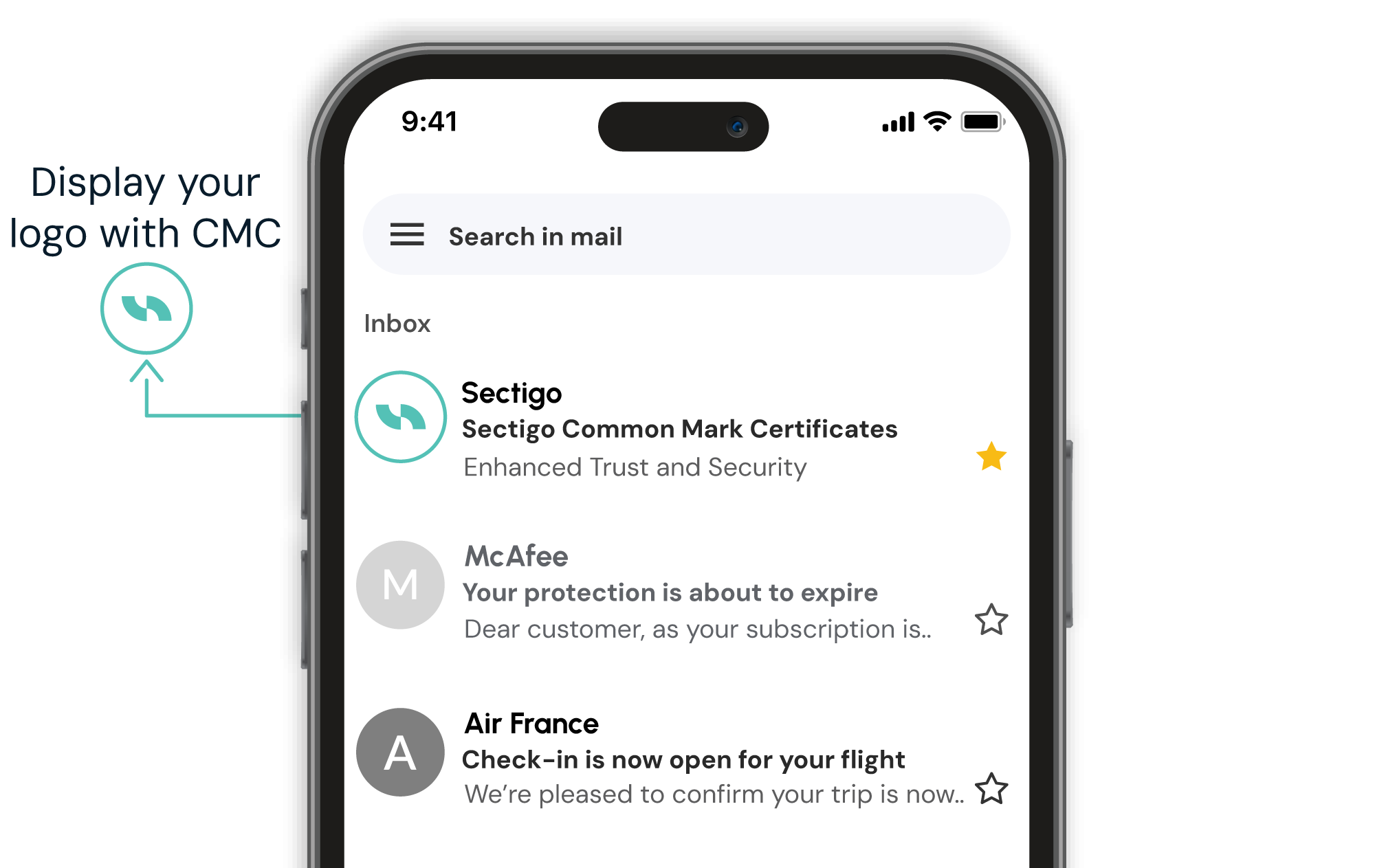
Choose CMC if:
A Verified Mark Certificate, or VMC, is a digital certificate that verifies your organization is authorized to use its trademarked logo with BIMI. This type of certificate helps your logo appear in supported email inboxes, giving recipients a clearer signal that your message is legitimate. For Gmail, a VMC is also what enables the blue verified checkmark.
With a Sectigo Verified Mark Certificate, your trademarked logo, DMARC enforcement, and email authentication work together to deliver higher open rates, stronger brand recall, and better email performance. It’s a strong fit for marketers, brand managers, and email teams who want more visibility, credibility, and protection.
Verified Mark Certificates place your verified logo directly in recipients’ inboxes, helping your emails stand out as trusted and making impersonators easier to spot. Eliminate doubt, protect your reputation, and convert with confidence.
Verified Mark Certificates extend your visual brand into the inbox—reinforcing brand recognition and trust in one of the most crowded digital spaces. At the same time, they validate your email authentication standards, enhancing security, deliverability, and brand protection with every send.
Verified Mark Certificates don’t just secure your emails, they boost deliverability and visibility by verifying your domain meets the highest authentication standards, including DMARC, SPF, and DKIM. That means more emails land where they belong—with your customers.
Emails with verified logos are more likely to be opened and read. A clear visual cue builds confidence with your audience, helping improve open rates and conversion over time.
These requirements help establish trust, combat spoofing, and ensure brand logos are displayed securely.
DMARC is a security policy that helps stop attackers from sending fake emails using your domain. DMARC authentication is necessary for meeting BIMI specifications.
Your logo must be officially registered in a recognized trademark database (e.g., USPTO in the U.S.).
To order and collect your VMC, follow these six steps:
In order for your VMC to work properly, your email domain's DMARC policy should be set to "quarantine" or "reject" (not "none").
Your logo must be officially registered in a recognized trademark office.
Must be in square SVG format (required for BIMI compliance).
Add to Cart above and complete your purchase.
You will receive an email with instructions to help you complete and download your VMC.
Sectigo will verify your business identity, which may include reviewing registration documents and confirming identity via a notarized ID or video call.
Upload your SVG logo to a publicly accessible HTTPS URL, or allow Sectigo to host your logo for you.
If you're hosting your own logo, add a BIMI TXT record to your domain's DNS (your host or IT team can assist).
Use a BIMI testing tool to check if your email is configured correctly.
Send a test email to ensure your verified logo appears in inboxes.
Regularly monitor DMARC compliance to prevent issues.
Renew your VMC before it expires to maintain visibility.
Have another question?
Reach us by chat in the lower-right corner.
A Verified Mark Certificate (VMC) is a digital certificate that confirms ownership of a registered trademark logo and makes it eligible to appear in supported email inboxes through BIMI. This verified logo serves as a visual trust signal and helps protect against impersonation and fraudulent email activity.
To use a VMC, an organization needs proper email authentication in place, including DMARC enforcement. When these requirements are met, supported mailbox providers can verify that a brand is authorized to display its logo, helping recipients recognize legitimate emails more easily.
BIMI works by linking your email address to your brand’s logo using DNS records. To become BIMI compliant, companies must ensure that their emails are authenticated using SPF, DKIM and DMARC, then set up a DNS record that points to their logo image and VMC. SPF confirms who can send emails on your behalf, DKIM adds a digital signature to prove they haven’t been altered, and DMARC ties it all together to prevent spoofing and phishing. BIMI-participating mailbox providers like Gmail, Apple Mail and Yahoo check the BIMI record when receiving emails from the company’s email domain. If DMARC passes, it will verify if there is a BIMI record in DNS for the sender domain name (and so be re-directed to the VMC and logo image to display); if DMARC fails, it won’t look for BIMI.
A VMC is not required for every BIMI implementation, but Gmail and other participating mailbox providers require third-party logo verification for logo display. For Gmail, a VMC or CMC is required for BIMI logo display, but only a VMC enables the blue verified checkmark.
When recipients see familiar brand logos, they are more likely to feel confident that emails have been sent by reputable sources. VMCs facilitate logos, which offer a powerful form of visual reassurance. This makes recipients more likely to open and read emails. Furthermore, the email authentication protocols required to use VMCs can improve sender reputation and deliverability by minimizing the risk of brand spoofing. Google also shows a blue checkmark indicating the sender of this email has verified that they own the domain and the logo in the profile image.
Typically an organization's legal team can provide details around your trademark status. Having this data, you can look on the World Intellectual Property Organization's (WIPO) website and search for your organization's logo. Once you find your logo in the database, verify registration status (trademark must not expire within 397 days of verification), jurisdiction and a match between the logo you use in email and the trademarked version. As of September 2025, VMC guidelines officially recognize 17 intellectual property offices:
If your logo is not registered with a recognized intellectual property office, you need to go through the trademark registration process in the appropriate jurisdiction. This process can take months, so plan ahead. Alternatively, if your organization is unable to register their logo, or is looking for a more accessible path to BIMI compliance, you may want to start with a Common Mark Certificate (CMC) which allows your organization to display your logo in emails without a trademark.
VMC validation consists of:
To streamline issuance, it’s best to complete your trademark registration and have all necessary documentation ready before applying for a VMC.
Before starting the setup process, we recommend having the following information ready. This will help you move through the setup smoothly without losing progress.
Your logo must be:
You can use tools provided by the BIMI Group or manually edit the SVG file using a text editor to ensure compliance.
No, logo display depends on whether the recipient’s email client supports BIMI. VMCs are recognized by major providers like Gmail and Yahoo, but not all email services have adopted BIMI yet. While VMC ensures your logo is eligible to display, actual visibility depends on client-side support and configuration.
Sectigo Verified Mark Certificates start at $1,350 per year if you choose a multi-year subscription. Pricing varies based on certificate terms and the number of domains. If your organization is not ready for a VMC or does not have a registered trademark, a Common Mark Certificate may be a more accessible, lower-cost starting point for BIMI logo display.
Securing some of the world’s largest and best-known brands.
Contact our team for help with your purchase or issuing your certificate.
Click the button below or click "Chat with an Expert" to start chatting with us now!
Email is key for engagement but risky. Sectigo Verified Mark...
VMCs display logos in email clients to boost trust, security,...
Messages in Gmail often display blue checkmarks next to verified...